


Kagame Regime Just Boasted of a $301 Million Savings Rate: Embarrassingly, the Math Shows Rwanda Is a Regional Midget
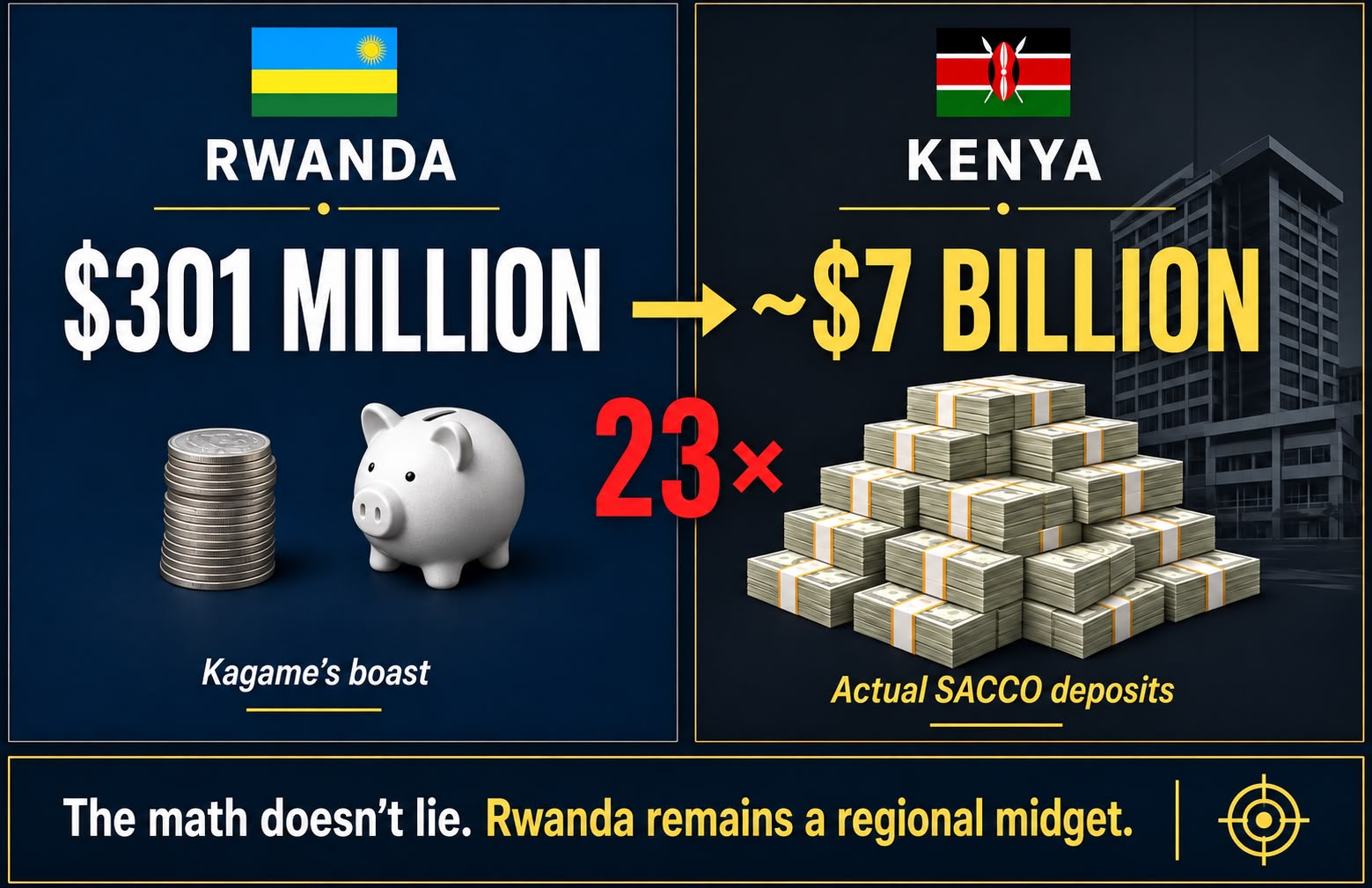
The regime of General Paul Kagame never tires of manufacturing triumphs from thin air. It just proudly touted that Rwandans had collectively amassed Rwf 445 billion in local SACCOs and community savings schemes. In isolation, $301 million USD is packaged as a triumphant milestone for a nation still recovering from a fractured history.
The boast is an embarrassment.
Economic development does not happen in a vacuum. Placed side-by-side with its regional neighbors, Rwanda’s hyper-managed financial ecosystem looks less like a roaring lion and more like a carefully manicured house of cards.
Enter the Real Powerhouse: Kenya vs. Rwanda
To understand just how tiny Rwanda’s financial footprint remains, look across the border to Kenya. Kenya does not need slick foreign analogies because its economic reality speaks for itself. In the realm of grassroots financial mobilization, Kenya’s regulated SACCO sector alone holds roughly $6.4–7 billion USD in member deposits (KSh 833 billion range in the latest supervision data), with total assets exceeding $9 billion and climbing past the KSh 1.2 trillion mark.
The brutal mathematical reality of that disparity:
The 20-plus-to-1 gap: Kenya’s cooperative savings pool is more than twenty times larger than the figure the Kigali regime is celebrating.
Asset domination: Kenyan SACCOs function as genuine institutional engines. They fund commercial real estate, infrastructure, and private enterprise at scale. These are not decorative piggy banks for rural farmers under state supervision.
The regulatory contrast: Rwanda leans heavily on top-down, government-directed schemes that prioritize compliance and visibility. Kenya has a mature, largely citizen-driven cooperative system regulated by SASRA that operates as a robust secondary banking sector with real market depth.
Even after adjusting for population—Kenya is roughly four times larger—the gap remains humiliating. A structural deficit of this magnitude cannot be papered over by clean streets, orderly traffic, or glossy conference speeches.
The Broken Promises of Vision 2020
The gap widens into a chasm when the lens shifts to macroeconomic output. In 2000, Paul Kagame launched Vision 2020, a grand development framework explicitly designed to transform Rwanda into a middle-income country by that year. The deadline came and went. The promise was thoroughly broken.
Kenya stands as a lower-middle-income economy with a nominal GDP in the $136–151 billion range. Rwanda crawls far behind with roughly $16–19 billion. Kenya’s economy remains roughly eight times larger.
On a per-capita basis the “Singapore of Africa” illusion collapses completely: Kenya’s GDP per capita sits in the $2,300–2,800 range while Rwanda remains stuck near $1,100–1,300. After more than a quarter-century of tightly controlled rule sold as hyper-growth, the average Kenyan still commands more than double the economic output of the average Rwandan.
IMF rankings deliver the final blow. Rwanda continues to hover near the bottom of the global GDP-per-capita table, ranking in the high 170s. That is not a temporary lag. It is the measurable result of an economic model optimized for optics rather than broad-based capital formation.
A Midget in a Room of Giants
It is not only Kenya that exposes the Rwandan mirage. Even Tanzania, often caricatured as slower and more bureaucratic, maintains a far larger footprint in microfinance and cooperative assets than the figure Kigali is currently celebrating.
Rwanda’s model is an exercise in extreme optimization: a small population under centralized control, producing highly visible but shallow indicators. Kagame has built an impressive showcase window. The inventory in the back of the store remains remarkably thin.
The Bottom Line
Clean streets do not equal full pockets. A frictionless business registry does not automatically manufacture a prosperous middle class. Controlled savings schemes that look impressive in a government report do not substitute for genuine, citizen-owned capital that can compete regionally.
While Kigali continues to chase the ghost of Lee Kuan Yew, the actual economic engine of East Africa remains firmly anchored in Nairobi. Until Rwanda’s top-down directives translate into capital depth that can stand on a regional stage without constant PR amplification, the “Singapore of Africa” will remain exactly what it has always been: a brilliant marketing slogan masking a low-income reality.
Discussion

No comments yet. Be the first to comment.