


Kagame’s Economic Delusions: How Rwanda's Own Data Exposed the World Bank's Cheerleading
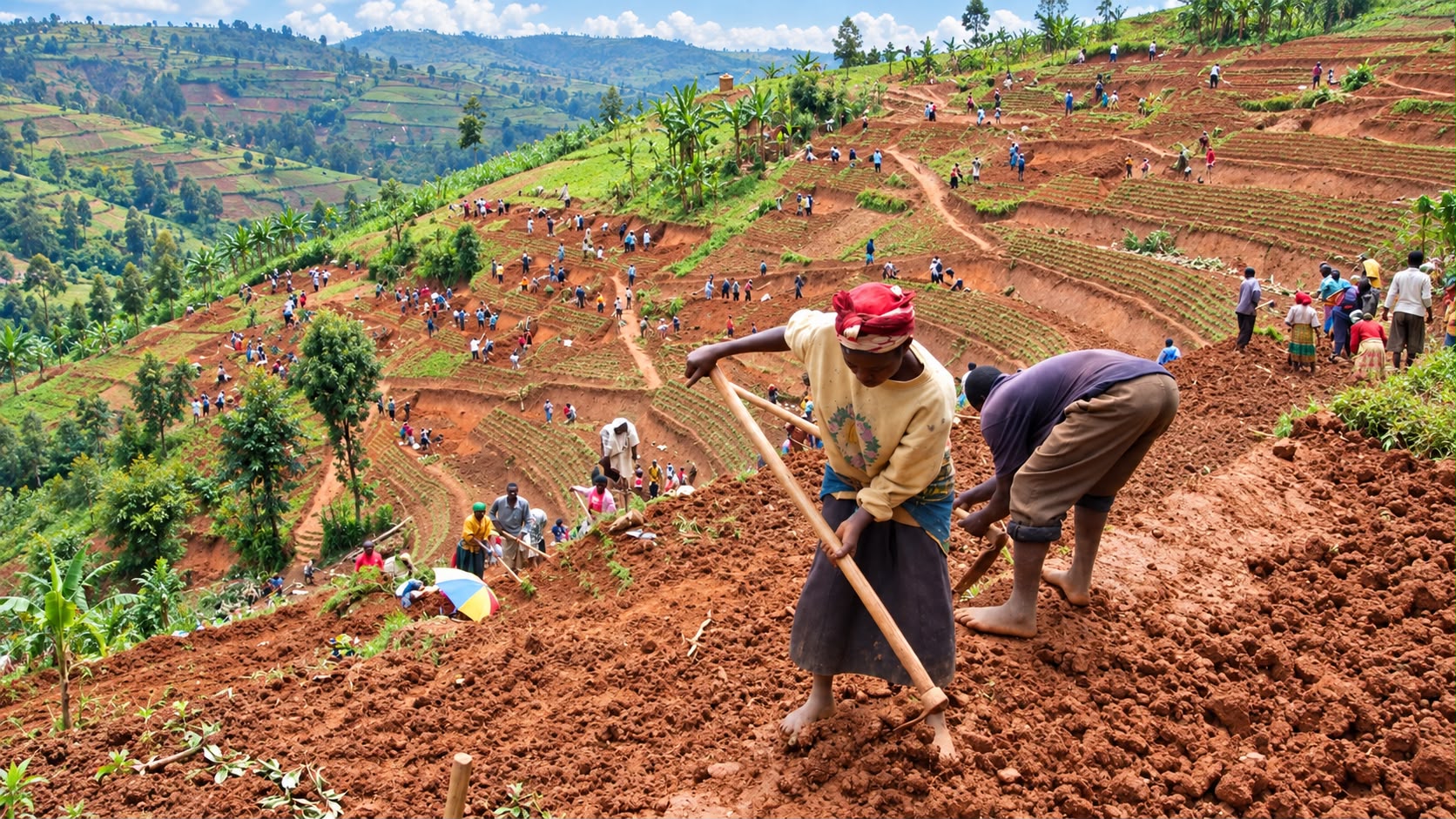
The World Bank is not just an embarrassing cheerleader. It is the loudest, most shameless one in the room—cheering louder than the regime it props up.
According to the Bank’s latest propaganda, poverty in Rwanda has fallen from 72% in 2005 to a mere 37% in 2025, measured against the international poverty line of $3 a day. Cue the glossy infographics, the donor conferences, and the solemn speeches about the “Rwandan miracle.”
There is only one problem: Rwanda’s own official numbers expose the claim as statistical fraud.
The Math That Destroys the Myth
The National Institute of Statistics of Rwanda’s 2025 Statistical Yearbook and Labour Force Survey data show that the average monthly wage for paid employment was RWF 73,948. At prevailing exchange rates, that works out to roughly $50 a month.
Let's break down the basic math the World Bank refuses to do:
· Average monthly wage: $50
· Formal work month: 22 days
· Average daily wage for a paid worker: $2.28
$2.28 is less than $3.00.
By the World Bank’s own definition of poverty, the average formal wage-earner in Rwanda is still poor. If the people who actually hold paid jobs cannot clear the poverty line, the claim that only 37% of the country is impoverished is not an optimistic estimate. It is a lie.
The Informal Economy Illusion
And those paid jobs are the privileged minority. In Kagame’s Rwanda, 91.2% of Rwandan employment is informal. This means:
· Day labourers
· Subsistence farmers
· Street vendors
· People scraping together seasonal work and erratic hours
If a formal employee working full-time hours is only clearing $2.28 a day, the nine-tenths of the workforce trapped in the informal economy are not “living just above poverty.” They are drowning in it.
A Society Structurally Destitute
Rwanda’s workforce sits at 4.8 million people. That fragile, underpaid base is expected to support a total population of about 14.9 million. Every single underpaid worker is carrying multiple dependents—children, elderly relatives, and the unemployed.
When the breadwinners themselves fail the global poverty test, the entire society is structurally destitute. There is no middle class waiting to be celebrated. There is only a mass of people surviving on scraps while international donors clap for GDP percentages.
The Mirage is Falling Apart
You cannot eat World Bank press releases. You cannot pay rent with donor applause. And you absolutely cannot redefine poverty out of existence by measuring national accounts instead of what human beings actually earn.
The data is public. It comes straight from Kigali’s own statistical machinery. It proves that the average Rwandan worker is poor by the exact international standard the World Bank itself promotes.
The “miracle” is a carefully curated mirage—sustained by selective metrics, suppressed contradictions, and institutions more interested in protecting a preferred narrative than telling the truth. It is time the cheerleaders put down the pom-poms and look at the numbers they keep pretending not to see.
Discussion


No comments yet. Be the first to comment.