


How Do Rwandans Earn Their Living? Understanding the Harsh Realities of Employment In Kagame’s “Singapore of Africa”
Rwanda is frequently praised in international circles as a glittering success story of development. Often dubbed the “Singapore of Africa,” the country conjures images of immaculate streets in Kigali, progressive drone delivery networks, and ambitious tech summits. However, pulling back the curtain on actual employment statistics reveals a starkly different reality for the vast majority of the population.
According to official data drawn directly from the National Institute of Statistics of Rwanda’s 2025 Rwanda Statistical Yearbook, out of a total population approaching nearly 15 million people, only 4,706,000Rwandans are officially employed. This low employment-to-population ratio is just the surface of a much deeper structural problem. When we analyze exactly how these 4.7 million citizens earn their living, the illusion of a highly modernized, tech-driven economy quickly evaporates.
Trapped in the Informal Sector
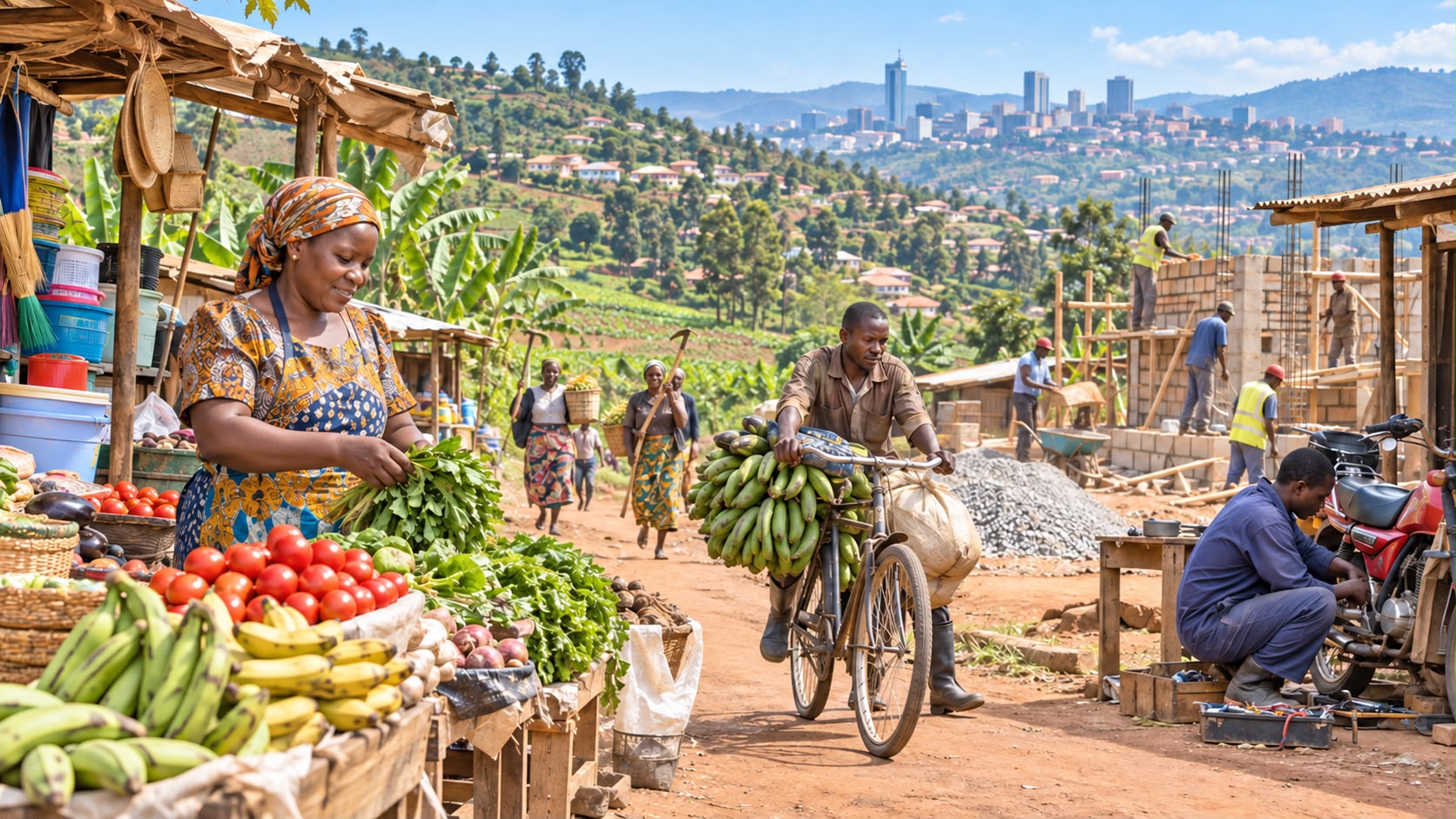
The most telling metric of Rwanda's economic landscape is that an astonishing 91.2% of working Rwandans remain trapped in the informal sector. Far from the high-tech, corporate jobs envisioned in state propaganda, the overwhelming majority of the workforce survives day-to-day on precarious, low-paying, and unprotected labor.
This informality is anchored by three main pillars: subsistence agriculture, informal trading, and manual construction. Agriculture alone accounts for nearly 40% of all employment, keeping millions bound to small plots of land with minimal mechanization. Wholesale and retail trade—largely consisting of roadside kiosks, small-scale market stalls, and informal trading—makes up another major chunk. Construction, though booming on paper through Kigali's shiny infrastructure projects, relies heavily on informal, low-wage day laborers who lack job security or benefits.
The Dismal State of the Modern IT Sector
While the government heavily promotes its digital transformations, hosting high-profile international tech summits and rebranding Kigali as an innovation hub, the official data shows that Rwanda's modern tech economy barely exists. The Information and Communication (IT) sector is shockingly dismal, employing a minuscule 19,000 people nationwide. That represents a microscopic fraction—just 0.4%—of the entire working population.
This footprint is so small that it essentially functions as a statistical rounding error. For all the rhetoric surrounding tech incubators, coding academies, and the digitization of public services, the sector has utterly failed to become a meaningful engine of mass employment. The reality is that the high-tech "Singapore of Africa" is a narrative enjoyed by a small urban elite and visiting expatriates. For the average citizen, the digital age remains completely out of reach as the domestic job market fails to absorb aspiring tech professionals. Other vital components of a modern knowledge economy—such as professional, scientific, and technical activities, or financial services—fare just as poorly, proving that the foundation of the Rwandan workforce remains heavily manual and agrarian.
Employment by the Numbers: Where Rwandans Actually Work
The following breakdown from the 2025 Rwanda Statistical Yearbook illustrates the distribution of Rwanda's 4,706,000 employed individuals across various sectors, ordered by workforce size:
• Agriculture, forestry and fisheries: 1,841,000 workers (39.1%)
• Wholesale and retail trade; repair of motor vehicles and motorcycles: 763,000 workers (16.2%)
• Construction: 417,000 workers (8.9%)
• Transportation and storage: 308,000 workers (6.5%)
• Manufacturing: 256,000 workers (5.4%)
• Education: 191,000 workers (4.1%)
• Accommodation and food services activities: 175,000 workers (3.7%)
• Other services: 164,000 workers (3.5%)
• Activities of households as employers: 159,000 workers (3.4%)
• Administrative and support activities: 119,000 workers (2.5%)
• Mining and quarrying: 77,000 workers (1.6%)
• Public administration and defense; compulsory social security: 75,000 workers (1.6%)
• Financial and insurance activities: 54,000 workers (1.1%)
• Professional, scientific, and technical activities: 36,000 workers (0.8%)
• Human health and social work activities: 35,000 workers (0.7%)
• Information and communication (IT): 19,000 workers (0.4%)
• Real estate activities: 15,000 workers (0.3%)
• Water supply, gas and remediation services: 11,000 workers (0.2%)
• Arts, entertainment, and recreation: 9,000 workers (0.2%)
• Activities of extraterritorial organizations and bodies: 6,000 workers (0.1%)
• Electricity, gas stream and air conditioning supply: 2,000 workers (0.04%)
Conclusion
The numbers do not lie. The numbers here are after all drawn from the horse’s mouth — the National Institute of Statistics of Rwanda. While Rwanda makes noise about being the Singapore of Africa with impressive streets of the capital city of Kigali, its economy has failed to generate the formal, high-value jobs required to support its young and growing population. With over nine out of ten workers operating in the informal economy, and IT employment effectively treating a tech-hub dream as a statistical rounding error, the "Singapore of Africa" moniker remains a distant aspiration rather than a lived reality for ordinary Rwandans.

No comments yet. Be the first to comment.