


The Youth Has No Future Under Kagame — Take a Look at Institutions of Higher Learning of Rwanda and their Failure in Developing Human Capital, Compared to Neighboring Uganda and Kenya
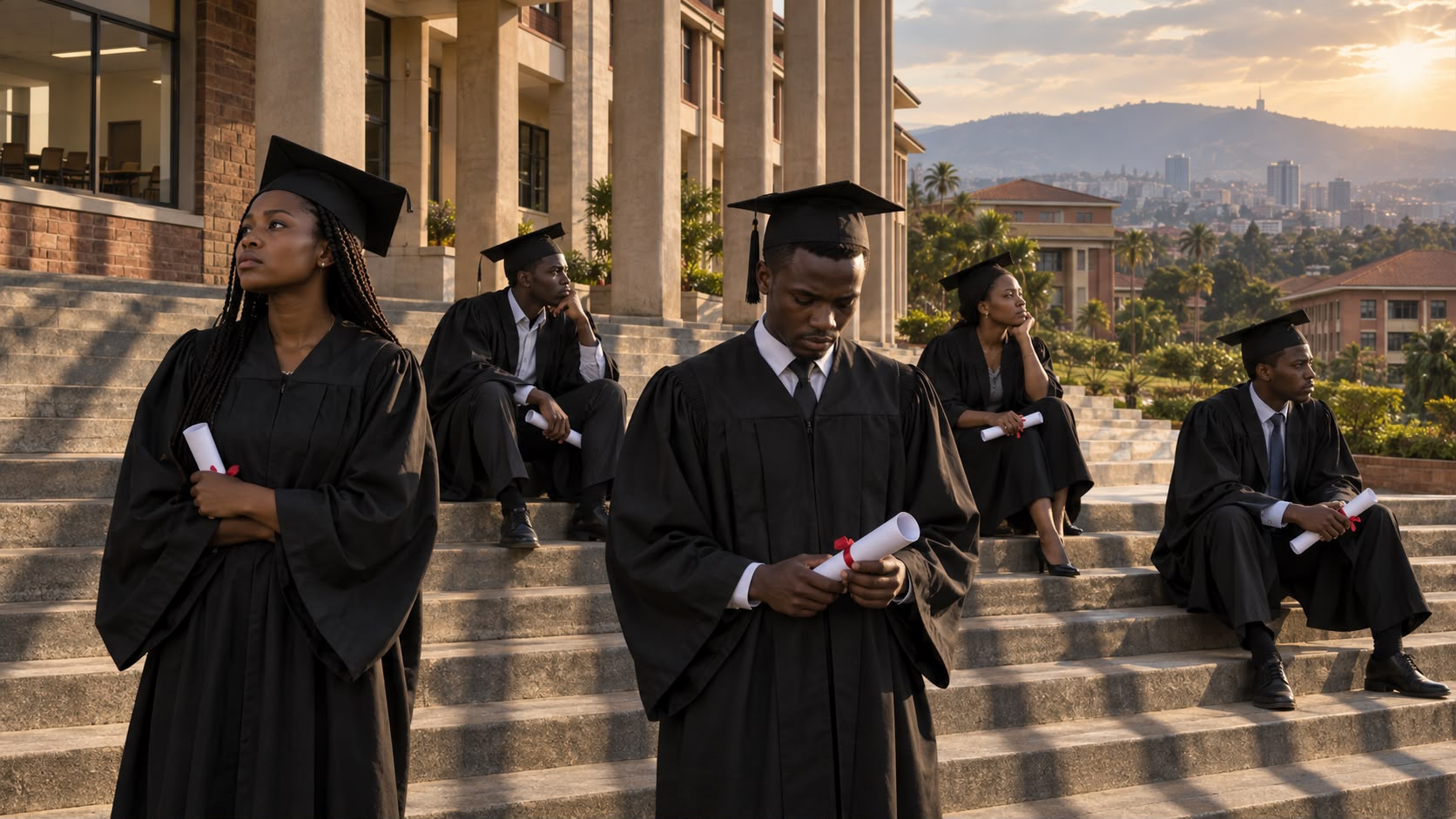
For decades, the international community has swallowed a carefully manufactured narrative: Rwanda is a shiny, efficient tech-hub, a beacon of African modernization rising from the ashes. But behind the pristine streets of Kigali lies a devastating reality for the country’s largest demographic. The youth of Rwanda are being systematically left behind, trapped under an authoritarian regime that prioritizes optics over actual human capital.
Nowhere is this tragic failure more glaring than in Rwanda's institutions of higher learning. When compared directly to neighboring East African giants like Kenya and Uganda through a global lens, Rwanda’s university system reveals itself to be a shallow, underfunded, and strictly controlled intellectual desert. For the country’s youth, the message is clear: under Paul Kagame's regime, there is no future.
1. The Global Verdict: An Academic Desert
When evaluated on the global stage, the catastrophic state of Rwandan higher education becomes impossible to hide. True prestige on the international circuit is determined by independent metrics, research output, and institutional stability. In this arena, Rwanda does not just lag behind—it flatlines.
According to major global league tables, not a single Rwandan university ranks within the top 1,000 institutions worldwide. The state's flagship institution, the University of Rwanda, languishes far down the list, frequently buried in the 1501+ band of the Times Higher Education World University Rankings. On the broader continental stage, it struggles to even pierce the top 80 in Africa.
Contrast this global irrelevance with Rwanda’s immediate neighbors. In Uganda, Makerere University has achieved massive leaps, cementing its legacy as a global research force by climbing to 639th in the Worland, 23rd in Africa in major international assessments. In Kenya, the University of Nairobi routinely commands respect globally, ranking in the top 6.7% of universities worldwide via the Center for World University Rankings and placing ahead of competitors across multiple research subjects.
While Kenyan and Ugandan youth walk away with globally recognized degrees that command authority from London to New York, Rwandan youth are handed compromised certificates from an institution that the global academic community barely registers.
2. The Great Academic Flight: Brain Drain Exposes a Dying System
A university is only as good as its faculty, and this is where the Rwandan disaster transforms into a permanent crisis. Because the Kagame regime has turned higher education into an ideological prison, Rwanda is suffering from a devastating brain drain of its top academic minds and brightest researchers.
Faced with low wages, an aggressive lack of academic freedom, and constant surveillance by state intelligence, Rwanda’s elite scholars are fleeing the country. Rather than staying to build up the University of Rwanda, they seek refuge in regional giants like the University of Nairobi or Makerere University, or escape entirely to institutions in Europe, North America, and South Africa.
Exiled Rwandan scholars paint a chilling picture of what happens when independent thought crosses the regime. As one exiled academic noted anonymously out of fear for family members still inside the country: “In Rwanda, you do not write peer-reviewed papers; you write what the Rwandan Patriotic Front (RPF) wants to see. If your research uncovers a statistic that contradicts the state's narrative of economic growth or ethnic harmony, you aren't just rejected by a journal—you are labeled an enemy of the state.”
The suppression goes beyond data to the very core of intellectual life. Another prominent academic who fled to Europe after facing administrative threats explained: “The University of Rwanda is no longer an institution of higher learning. It is an administrative arm of the RPF. Professors spend more time proving their political loyalty and self-censoring their lectures than actually reading new research. We left because the alternative to exile was intellectual death, or worse, physical disappearance.”
This mass exodus leaves Rwandan classrooms severely understaffed and deprives youth of the high-caliber mentorship they desperately need. While Kenya and Uganda successfully retain deep talent pools of seasoned professors, international grant-winners, and visionary researchers, Rwanda’s lecture halls are increasingly populated by underqualified, intimidated, and temporary staff.
When a nation's top scholars refuse to work within its borders, it is the youth who pay the price, forced to learn from a hollowed-out faculty incapable of offering a globally competitive education.
3. The Forced Merger: Chaos as a Policy
In 2013, the Kagame government forcefully consolidated all of Rwanda’s independent public higher education institutes into a single entity: the University of Rwanda. What was marketed as a move for "efficiency" was actually a calculated effort to centralize control and mask systemic underfunding.
Instead of creating a mega-university of excellence, this consolidation resulted in bureaucratic chaos. Campuses are scattered, understaffed, and deprived of resources. Rather than fostering unique hubs for medicine, agriculture, or engineering, the regime created a bloated, dysfunctional monolith where students are treated like numbers on a spreadsheet.
4. The Language Experiment: Sacrificing a Generation
Perhaps the most brutal blow dealt to Rwandan youth was Kagame’s sudden, politically motivated decree overnight to switch the country’s entire education system from French to English.
Education cannot be rewritten by executive fiat without consequences.
Unprepared Educators: Teachers and lecturers who had taught in French for decades were suddenly forced to teach complex academic concepts in a language they barely understood.
Illiterate Literacy: A generation of students became functionally illiterate in the professional world—not fully fluent in French and inadequately trained in English.
While youth in Kenya and Uganda benefit from decades of established, stable English-medium instruction, Rwandan youth were turned into guinea pigs for a reckless geopolitical experiment.
5. Ideological Subservience vs. Academic Freedom
True higher education requires a culture of critique, skepticism, and free thought. In Rwanda, these concepts are treated as political crimes.
At Makerere or Nairobi, universities are hotbeds of political debate, intellectual friction, and social progress. Students question their governments, challenge policies, and learn to think as independent leaders.
In Rwanda, the state university is an extension of the regime.
State Espionage: Campuses are heavily monitored by state intelligence.
Forced Conformity: Students are subjected to mandatory solidarity camps (Ingando), which critics call ideological indoctrination centers designed to instill absolute obedience to the ruling party, the RPF.
Fear Over Faculty: Professors practice strict self-censorship out of fear of dismissal or imprisonment.
You cannot build a "knowledge-based economy" when you terrify the minds responsible for creating that knowledge. Kagame’s system does not produce innovators; it produces compliant bureaucrats.
Conclusion: Wake Up and Demand a Future
The Kagame regime loves to showcase international boutique campuses like Carnegie Mellon University Africa to foreign dignitaries. But these elite, prohibitively expensive institutions are completely out of reach for the vast majority of ordinary Rwandan youth. They serve as a cosmetic mask over a rotting public education system.
While Kenyan and Ugandan youth graduate from universities that teach them to conquer the regional and global job markets, Rwandan youth are handed compromised degrees from a shackled institution. Under Kagame’s regime, higher education is not a tool for empowerment—it is a mechanism of control. As long as this dictatorship prioritizes policing the minds of its youth over educating them, the future of Rwanda will remain fundamentally compromised.


No comments yet. Be the first to comment.