


RwandAir Will Bankrupt Rwanda: But Kagame Doesn’t Give a Damn — All He Cares About Is a Showy Airline to Impress
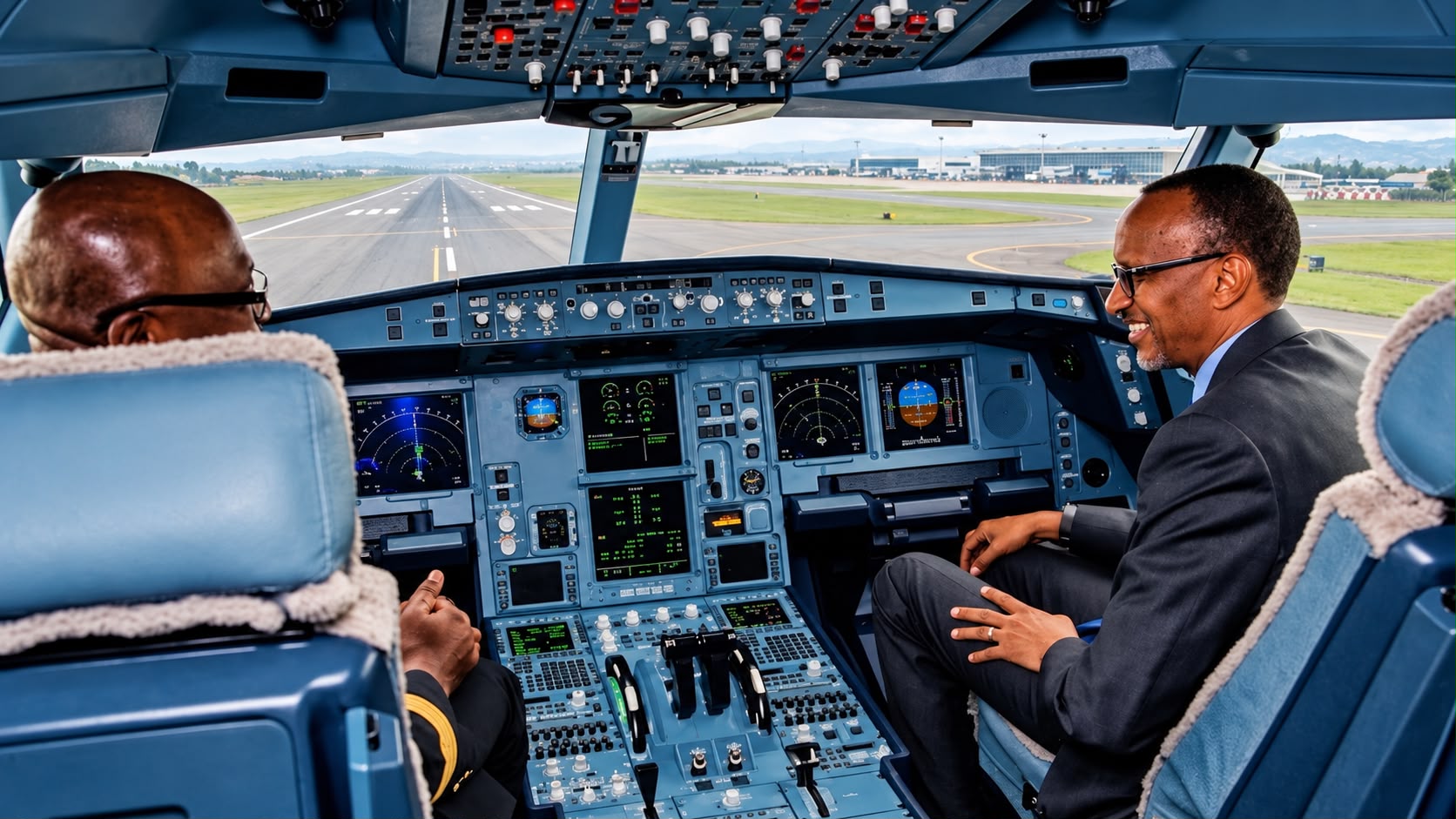
For over two decades, the Government of Rwanda has poured scarce public resources into a financial black hole with wings.
By conservative estimates, President Paul Kagame’s administration has injected well over $1.5 billion to $2 billion USD in direct subsidies, bailouts, and debt recapitalizations into RwandAir. In a landlocked country navigating heavy fiscal constraints, any standard economic playbook would demand an immediate restructuring—if not a complete grounding—of an enterprise that has failed to turn a profit since its inception.
But Kagame doesn’t give a damn. To him, RwandAir isn't a business; it is a multi-billion-dollar vanity project designed to project global influence and impress international onlookers.
The 2026 IMF Shock: The Bailout Loop Never Ends
If anyone thought the post-pandemic economic recovery or the highly anticipated Qatar Airways partnership would finally sever RwandAir from the state’s life support, this year delivered a harsh dose of reality.
According to recent disclosures from the International Monetary Fund, the Rwandan government quietly engineered yet another massive $80 million USD bailout for the national carrier in 2026.
This latest injection follows a clear, escalating pattern of state dependence:
- In 2014/2019, the average annual bailout of RwandAir was $70 million USD.
- In 2020/2021, the government provided a $153 million USD pandemic emergency bailout.
- In 2023, the carrier received a $160 million USD direct subsidy to stay afloat.
- In 2026, the IMF disclosed a brand new $80 million USD bailout.
This $80 million USD infusion highlights a dangerous, never-ending cycle. While the treasury strains under rising sovereign debt, the government continues to prioritize a bleeding airline over critical public infrastructure, healthcare, and education. It confirms what critics have long warned: RwandAir is an unsustainable dependency, surviving entirely on the backs of Rwandan taxpayers and international lenders.
The Sovereign Trap: Public Debt Approaching the 80% Threshold
The continuous financial lifelines extended to RwandAir are accelerating a broader, much more dangerous structural crisis: Rwanda’s total public debt is rapidly closing in on 80% of its GDP.
Driven heavily by capital-intensive vanity infrastructure like the national airline and the new international airport, the accumulation of non-concessional external borrowing is projected to push the country's public debt level to 79.1% of GDP by 2027. Rwanda's total foreign debt burden continues to hover around a staggering $12 billion USD. This trajectory places the country on the precipice of high debt distress, transforming what the regime markets as a forward-looking "investment strategy" into a sovereign trap.
What makes this debt surge catastrophic is that it is happening at the exact moment Rwanda’s traditional financial cushion is vanishing. For decades, the regime relied heavily on external budget support in the form of highly favorable grants. Today, that foreign aid has tanked, leaving the central treasury exposed.
The immediate financial shortfall highlights how rapidly the ground is shifting:
- The U.S. Funding Collapse: In 2025, U.S. foreign assistance obligations to Rwanda sat at roughly $210 million USD. In 2026, amid the "America First" strategy overhaul and sweeping global health assistance cuts, targeted direct allocations face a steep 97% reduction.
- Cancelled European Support: In the fiscal year 2025/2026, $110 million USD in expected global grants failed to materialize entirely, compounded by Belgium cancelling $5 million USD in bilateral support.
With grants evaporating and budget gaps widening, the government has been forced to make a desperate pivot. To cover the difference and keep its infrastructure dreams on life support, Rwanda is turning away from concessionary development loans and aggressively embracing riskier, high-interest external commercial financing. The state's baseline economic plan now assumes nearly $800 million USD in external commercial borrowing spanning the 2026–2030 window alone. Because commercial loans carry significantly higher interest rates and strict repayment terms, the cost of servicing this $12 billion debt pile will systematically consume an ever-larger portion of domestic revenues.
Doubling Down on Excess: The New Aircraft Purchases
Instead of trimming the fleet to match realistic regional demand or adapting to this brutal new debt reality, Kagame’s regime continues an aggressive, capital-intensive expansion. Rather than scaling back, RwandAir has doubled down on long-haul ambitions. The airline is pushing ahead with a major long-haul fleet overhaul, acquiring and leasing an additional wave of five Airbus A330s alongside Boeing 737 MAX narrowbodies to service vanity routes across continents.
The cost of this posturing is staggering. In the global aviation market, a single new Airbus A330neo base model carries an estimated market value of roughly $107 million USD, with monthly lease rates escalating past $800,000 to $900,000 USD due to acute widebody supply bottlenecks.
Meanwhile, standard Boeing 737 MAX 8 narrowbodies command heavy commitments averaging $400,000 USD per month in leasing expenses alone. When compounding the multiple active orders, financing arrangements, maintenance contracts, and insurance premiums, the latest fleet scaling represents an estimated capital exposure and lease liability easily eclipsing $500 million USD.
Flying these expensive widebody jets half-empty across continents does wonders for the country’s marketing imagery, but it remains financially ruinous for an economy of Rwanda's size.
The capital costs ensure that the airline's monthly burn rate remains catastrophically high, funded directly by rising national debt risks.
Prestige Over Profit: The Aviation Ecosystem Illusion
The state’s defense of this endless spending has always centered on the concept of the aviation ecosystem. The administration argues that RwandAir acts as a loss-leader to drive luxury tourism, fill the Kigali Convention Centre, and position Rwanda as the Singapore of Africa.
To back this up, officials point to the massive Bugesera International Airport project, backed by a deal where Qatar Airways agreed to take a 49% stake in RwandAir and 60% of the airport.
But a closer look reveals a fragile house of cards. While Qatar Airways brings capital, the Rwandan state remains saddled with historical debts and the massive domestic infrastructure liabilities required to keep the deal alive. Pushing millions into aircraft leases while absorbing $80 million USD bailouts pushes Rwanda’s debt-to-GDP ratio into dangerous territory. A tourism sector entirely dependent on a heavily subsidized, unprofitable state airline is not a self-sustaining economy—it is an illusion bought and paid for by the state treasury.
The Verdict: A Luxury Show at the Expense of the Public
A national airline should serve its people, not just the image of its leader. By treating RwandAir as a diplomatic billboard rather than a commercial entity, Paul Kagame is playing a high-stakes game with the country's financial stability.
As long as international lenders tolerate these bailouts and the regime values prestige over fiscal sanity, the treasury will keep bleeding. RwandAir might not completely bankrupt Rwanda tomorrow, but it is actively robbing the population of the real, grassroots development funding they deserve—all so a showy airline can keep turning heads on the tarmac.
No comments yet. Be the first to comment.