


To Understand Kagame’s Rwanda, Look at Its Shocking Statistics—Not Kigali’s High-Rises
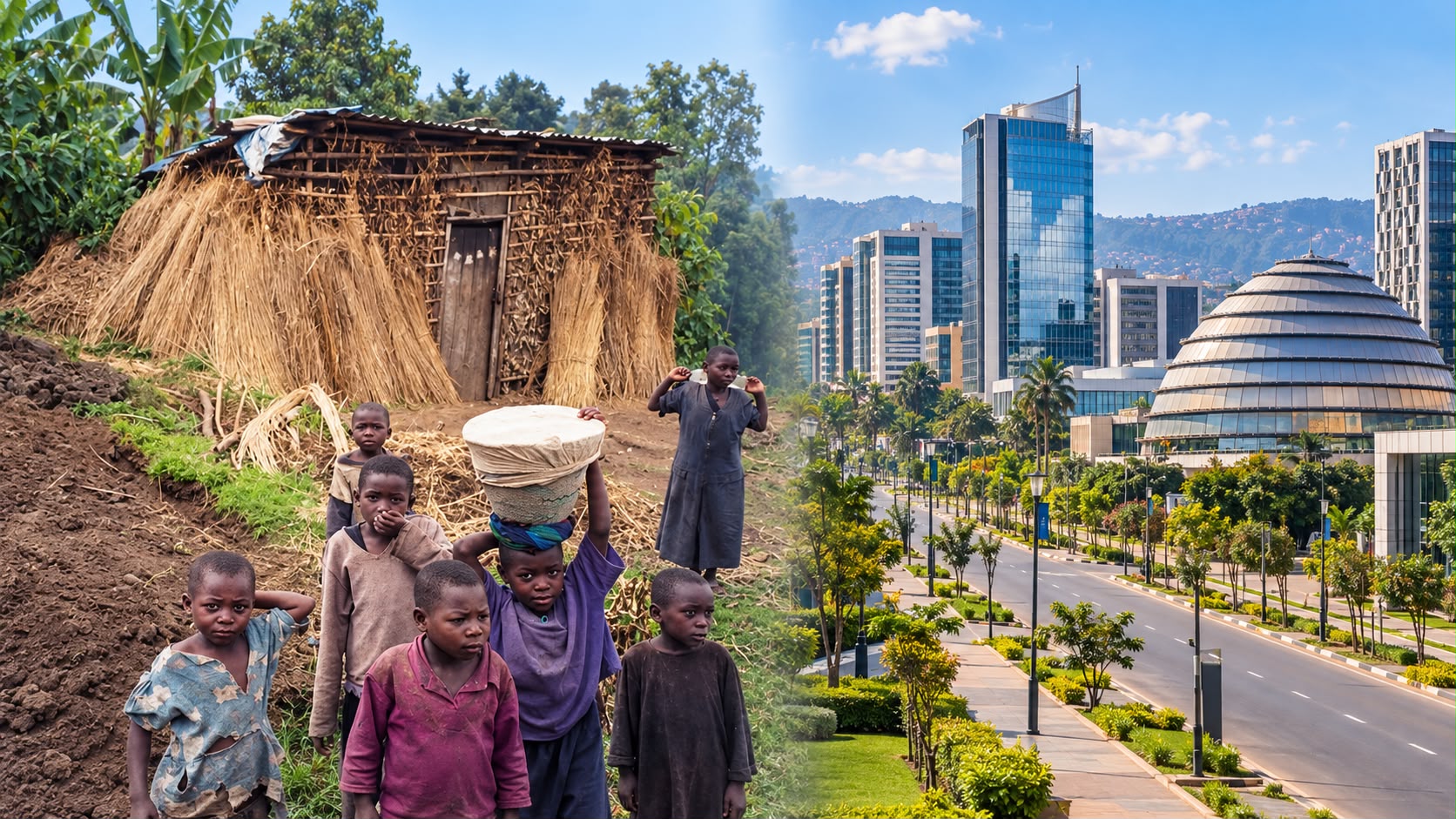
When a tourist arrives in the Rwandan capital city, they are immediately impressed, quickly agreeing that Kigali is Africa’s cleanest city. Between the airport and downtown, one is mesmerized by tree-lined boulevards and ultra-modern buildings along the way. Visitors arrive at five-star hotels complete with elegant convention facilities that welcome guests from around the world.
Unknown to the visitor, it’s all a carefully orchestrated show. Just a kilometre from those luxury hotels in any direction, hidden away, is the real Rwanda—one of the poorest and most vulnerable countries on the planet.
To understand the profound disconnect between the polished image and the grim reality, one only needs to look at the country's foundational data.
Take a look at the real Rwanda in statistics:
The Workforce and Deepening Poverty
- Population: 14.9 million
- Labour force population: 4.7 million
- Formal employment: 413,600 (only 8.8% of the workforce)
- Informal, irregular, and part-time employment: 4,286,400 (a staggering 91.2% of the workforce)
- Gross Domestic Product (GDP): $16.3 billion
- GDP per capita: $1,123 (ranking 170th globally)
- Multidimensional Poverty Headcount Ratio: 41.40%
The Trade, Debt, and Aid Dependency
- Exports of goods and services: $3.5 billion
- Imports of goods and services: $5.7 billion
- National Debt: $12 billion (rapidly approaching an 80% GDP ratio)
- Foreign aid: $1 billion
- Foreign aid received as a percentage of central government expense: 52.1%
The Impending Funding Crisis
- Foreign aid cuts by the US (Rwanda’s largest donor): Plummeting from $210 million in 2025 to just $13 million in 2026.
- Foreign aid cuts by the UK: Slashed from $41.5 million (£32 million) down to a residual baseline of $7.4 million.
The Anatomy of a Mirage: Why the Aid and Debt Crisis is Catastrophic
These figures completely dismantle the narrative of the "Rwandan economic miracle." For decades, Paul Kagame’s administration has used Kigali as a glossy public relations brochure to attract international prestige. But an economy where 91% of the workforce is trapped in precarious, informal labour is not a developing tiger—it is a house of cards.
Worse still, the fuel that kept this engine running is completely drying up. Historically, foreign aid funded over half of Rwanda's entire central government expenses. Now, the country’s two most critical benefactors have effectively pulled the plug. The United States is slashing its funding by over 93% this year, and the United Kingdom has reduced its baseline support to a fraction of its former self.
Without this massive influx of foreign cash, the government cannot sustain its infrastructure spend or its massive public relations apparatus. To make matters worse, Rwanda cannot simply borrow its way out of this hole. With a national debt already sitting at $12 billion— stretching toward 80% of its total GDP—the country is staring down a catastrophic sovereign debt trap.
When a nation imports far more than it exports, carries a crushing debt load, and loses its international donors all at once, the illusion cannot hold. The pristine streets of Kigali may look modern today, but the underlying data proves that the real Rwanda is on the precipice of a severe economic reckoning.
No comments yet. Be the first to comment.